

SEOUL, Republic of Korea, 18 November 2026 – Experts at the 10th Global Symposium on Low Fertility and Ageing called on governments to tackle the high housing costs, job insecurity and financial pressures that make it harder for young people to build the families they want.
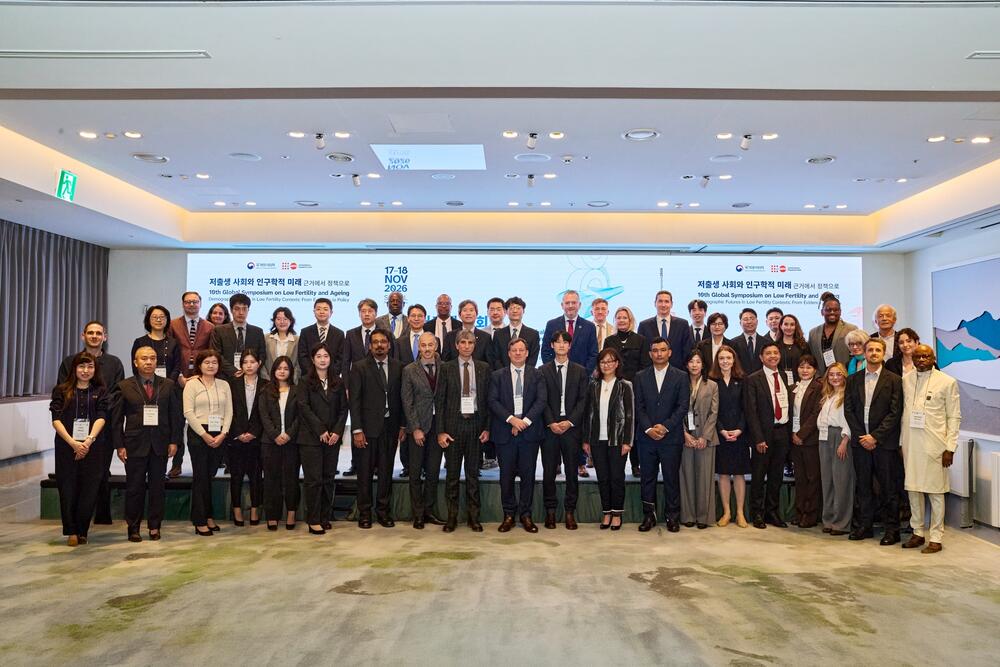
Co-hosted by the Republic of Korea’s Ministry of Data and Statistics (MODS) and UNFPA, the United Nations Population Fund, the symposium brought together policymakers and researchers from around the world to discuss how governments can support reproductive choice as populations change.
UNFPA data shows that many young adults value partnership and parenthood but face barriers to realising those aspirations. Among respondents, 88 per cent said financial security was important to feeling ready for parenthood, followed by stable employment (87 per cent) and emotional readiness (85 per cent). Seventy-two per cent cited economic and housing constraints as an important barrier to having children. The survey covered more than 108,000 internet-connected adults aged 18–39 across 73 countries and is not nationally representative.
“Young people are not giving up on relationships, families or the future, but too many feel that the conditions they need to realize their aspirations are increasingly out of reach,” said Pio Smith, UNFPA Regional Director for Asia and the Pacific. “We must rethink how we respond to low fertility, expand people's choices and create societies in which they can build the lives and families they want. This is at the heart of UNFPA's approach to demographic resilience.”
Experts urged governments to look beyond narrow fertility targets and short-term cash incentives. They highlighted sustained investment in affordable childcare, shared parental leave, flexible working arrangements and gender equality as ways to expand people’s choices and help societies adapt to population change.
“Low fertility is not an issue confined to a specific region or country, but a shared global challenge,” said Myung-ho Lee, Vice Minister of Data and Statistics of the Republic of Korea. “In particular, as the Republic of Korea is making an all-out, whole-of-government effort to effectively address demographic challenges such as low fertility and population ageing, this symposium, aimed at exploring practical and effective policy responses to low fertility, holds great significance,”
The symposium also marked 10 years of partnership between MODS and UNFPA under the Global Programme on Low Fertility and Ageing. The programme has helped governments strengthen their population data systems and use that evidence to develop policies that uphold people’s rights. Earlier this year, MODS and UNFPA agreed to extend the partnership for another five years through a memorandum of understanding.
Media Contacts:
Katie Elles (elles@unfpa.org), Regional Communications Adviser, Asia and the Pacific
Etienne Leue (leue@unfpa.org), Communications and Knowledge Management Specialist, UNFPA HQ (Nairobi)