

What does UNFPA do?
In Asia and the Pacific, UNFPA, works as a lead agency to prevent and respond to gender-based violence in 36 countries across humanitarian and development settings.
UNFPA GBV programming relies on evidence-based interventions adapted across the humanitarian–peace–development continuum, through multi-sectoral and comprehensive, coordinated action at every level, from national frameworks to individual case management. It is oriented towards increasing the resilience of individuals across their life course, communities and systems, linking prevention, preparedness and humanitarian response, including in the face of the climate crisis. It addresses GBV in all its forms, including technology-facilitated GBV, through an intersectional approach to reach women and girls in all their diversity.
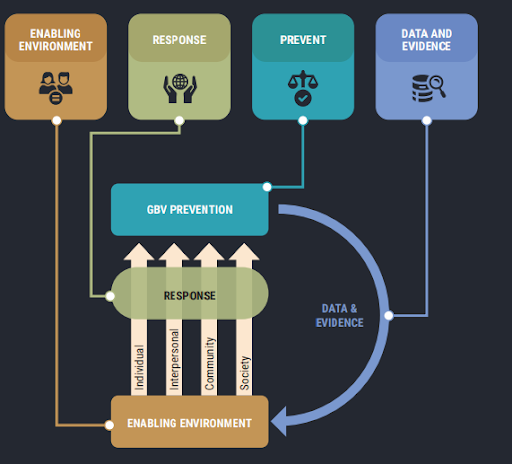
UNFPA GBV programming rests on four pillars that operate in synergy. We work to create an enabling environment that functions at every level of the socio-ecological model – individual, interpersonal, communal and societal – to prevent GBV from occurring. When it does, we tailor the response to meet the survivor’s individual needs within the context of her family, community and society. We systematically monitor and evaluate response and prevention efforts to yield data and evidence, along with conducting research and safe, ethical data generation and analysis to improve programming.
Response:
UNFPA response programming enforces a survivor-centred approach. That means survivors are the decision makers of the services they wish to use and the information they wish to share. It places the rights of survivors at the centre of every action, ensuring we treat each survivor with respect and dignity without discrimination.
UNFPA investment in partnerships, human capacity and physical infrastructure can enable survivors to access high-quality GBV case management. Quality case management makes available multi-sectoral response services adapted to the context in which survivors live and the forms of violence they experience, including technology-facilitated GBV.
Delivered by a trained social workforce with national-level accreditation, GBV case management links survivors to psychosocial support and cash/voucher assistance – as part of broader social protection systems that coordinate with child protection systems to serve all ages.
Safe spaces and integrated sexual and reproductive health and rights (SRHR) services strengthen social networks, offer empowerment opportunities and protect the bodily autonomy of women and girls. Emerging forms and patterns of GBV, including technology-facilitated GBV, are addressed through adaptable services that meet minimum standards in all settings.
Prevention:
GBV is a symptom of deep inequalities within a sociopolitical system. This means prevention of GBV requires a structural perspective identifying how these inequalities are produced, transmitted, enforced and sustained across generations and individual life courses.
At a community level, as social and gender norms shift towards gender equality, more people recognize systemic factors leading to gender inequities and oppose GBV.
UNFPA-led interventions include community mobilization; engagement of men and boys; parenting programmes; and comprehensive sexuality education programmes. These interventions foster dialogue to challenge discriminatory gender and social norms in addition to helping establish and sustain positive norms that promote gender equality and accountability for preventing violence against women and girls.
Social protection mechanisms, including reliance on cash and voucher assistance programmes, reduce GBV by mitigating the economic risk factors that make women and girls more vulnerable to intimate partner violence, sexual exploitation and sexual violence. Women and households with more access to financial resources, life skills, information on rights and social networks demonstrate strengthened resilience to shocks and stresses.
Increasingly, technology is being relied upon to reach those furthest behind and most vulnerable to increase accessibility to information and services. However, this opens a window of opportunity for the perpetration of technology-facilitated GBV and misinformation, thereby increasing harm. Preventing technology-facilitated GBV requires that technology is safely and ethically developed and used with women and girls at the centre of design, implementation and modifications. UNFPA works to bridge the gap between technology and GBV to create safe and ethical digital products and spaces that maintain progress towards gender equality.
Enabling Environment:
UNFPA supports an environment that enables women and girls to flourish without fear of violence. Our approach focuses on transforming structures and societal-level risk factors that perpetuate GBV.
As a result of UNFPA’s advocacy for compliance with international agreements, national governments and stakeholders ensure that women and girls, including GBV survivors, participate in decision-making about their rights and develop strategies to enact these rights in law and policy.
Partnerships with national human rights institutions, civil society organizations and feminist movements create a groundswell of action and accountability. Clear and realistic allocation of resources supports the implementation of national action plans and strategies to address GBV, including technology-facilitated GBV and in the context of climate change.
UNFPA recognizes that ending GBV is central to ensuring bodily and reproductive autonomy and full and equal access to sexual and reproductive health care, education and information. Hence, Universal Health Coverage incorporating SRHR and comprehensive care for GBV survivors, including addressing reproductive violence, is central to our approach. For example, mandatory reporting laws to receive specific sexual and reproductive health care and other provisions not compliant with human rights hinder help-seeking behaviours. They must be repealed to improve health outcomes of women and girls.
Technology can dramatically increase women and girls’ access to services and educational, economic and social opportunities. However, rights-based law reform to address responses to and prevention of technology-facilitated GBV is critical to ensure that women can access and use technology equitably.
Taken together, these initiatives build an environment for eliminating GBV, in which societies invest in the prevention of GBV, support women and girls in exercising their human rights to health and safety, and foster recovery and resilience for survivors.
Data and Evidence
UNFPA is committed to the safe and ethical collection, analysis and use of data and evidence, grounded in the imperative to do no harm and guided by international standards and best practices, including through the kNOwVAWdata Initiative and the GBV Information Management System .
The kNOwVAWdata Initiative ensures that the necessary capacity is available for countries to conduct prevalence surveys worldwide, including through mentoring and communities of practice in partnership with universities and research institutions to embed sustainability and regional and national leadership in perpetuating safe and ethical data collection and analysis.
The generation and use of administrative data to inform and guide effective case management through the GBV Information Management System remains a bedrock of GBV programming globally and an example of best practice for safe and ethical collection and analysis of incidence.
UNFPA also continues to scale up and invest in systems that monitor and evaluate evidence, resulting in quality, cost-efficient and scalable interventions.
Work to standardize terminology, indicators and data collection relating to emerging forms of GBV, including technology-facilitated GBV, reproductive violence and femicide, ensures their inclusion in data systems and informs policies, laws and programmes to address them.
Finally, and critically, it is important to understand and apply Indigenous knowledge and non-formal data collection systems to enhance an understanding of women’s and girls’ experiences of violence, including in the face of climate change.
----------------------
Change is a complex process. It requires action at many levels – from the individual to families, social networks, communities, organizations and institutions – in collaboration with a wide range of partners, including women-led organizations, feminist movements, academia and governments across the private and public sectors and civil society.
Together, we can make a difference. Together, we are building a shared vision of gender equality – transforming social and gender norms and cultivating spaces where women and girls can flourish without fear.
One of the most prevalent human rights violations in the world, gender-based violence (GBV) knows no social, economic or national boundaries. Despite many countries passing laws to address violence against women, weak enforcement of laws, deeply entrenched and persistent patriarchal social and gender norms continue to perpetuate gender inequality and gender-based violence (GBV) and harmful practices in the Asia Pacific region, challenging progress.
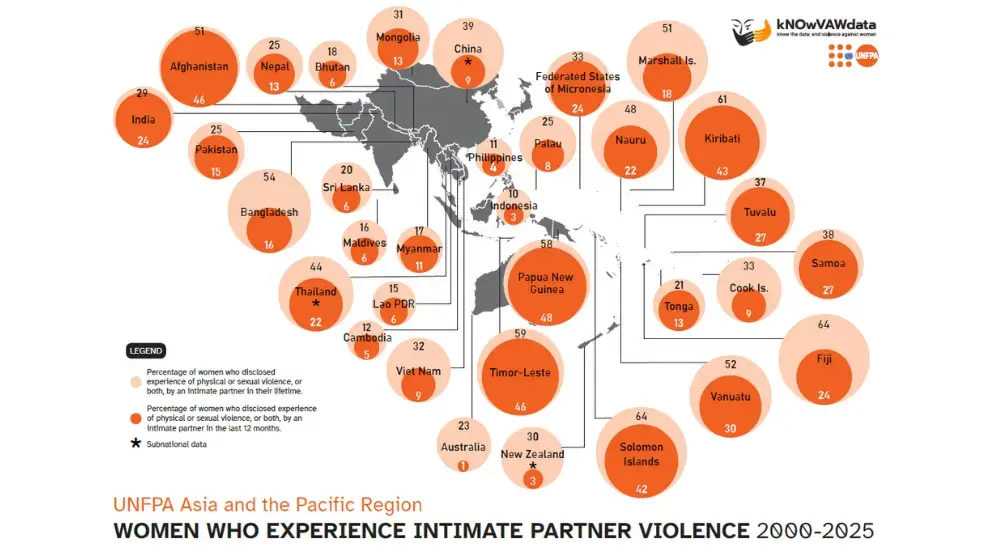
Globally, an estimated 736 million women — almost one in three — have been subjected to physical and/or sexual intimate partner violence, non-partner sexual violence, or both, at least once in their life. The Asia Pacific region has an average lifetime prevalence of intimate partner violence of 26 per cent among women, yet parts of the region, particularly the Pacific, have the highest rates globally. Women with disability, migrant and refugee women and girls, persons with diverse sexual orientation and gender identity and adolescent girls are at higher risks of experiencing various forms of gender-based violence and harmful practices due to structural inequalities. The region’s frequent exposure to natural disasters also heightens vulnerability to gender-based violence as crises intensify existing gender inequalities and weaken protective systems.
As the region is becoming increasingly digital, technology is also being used to enable, assist or amplify abuse or coercive control of a person or group of people leading to technology-facilitated gender-based violence. TFGBV often takes place in a continuum where online violence may lead to offline perpetration of violence or vice-versa.
Despite the high prevalence, gender-based violence often remains shrouded in a culture of silence. The wide acceptance of GBV as a common practice creates barriers for women and girls accessing services and few women seek formal support due to concerns over mandatory reporting, service providers’ bias and stigma. GBV services often lack survivor-centred approaches, and case management systems are inadequate.